vam-seek
VAM Seek - 2D Video Seek Marker
Visual Array Matrix Seeker — A JavaScript library for 2D video navigation.
Author: Susumu Takahashi (unhaya / haasiy)
A 2D visual seek grid for videos. Navigate any video by scenes, not timestamps. Client-side only. Zero server cost. Zero privacy risk.
-blue.svg)



https://github.com/user-attachments/assets/395ff2ec-0372-465c-9e42-500c138eb7aa
I built this because I was frustrated with blind scrubbing in long videos.
Stop Blind Scrubbing
| Traditional Seek Bar | VAM Seek |
|---|---|
| 1D timeline, trial-and-error | 2D grid, instant visual navigation |
| Server-generated thumbnails | Client-side canvas extraction |
| Heavy infrastructure | Zero server load, lightweight JS |
| Complex integration | One-line setup |
Quick Start
<!-- 1. Add the script -->
<script src="https://cdn.jsdelivr.net/gh/unhaya/vam-seek/dist/vam-seek.js"></script>

<!-- 2. Connect to your video -->
<script>
  VAMSeek.init({
    video: document.getElementById('myVideo'),
    container: document.getElementById('seekGrid'),
    columns: 5,
    secondsPerCell: 15
  });
</script>
That’s it. See docs/INTEGRATION.md for full documentation.
Alternative: Standalone Demo
Want a ready-to-use page without integration? Download deploy/demo/index.html - a single HTML file with all features built-in. No library import needed.
API
const vam = VAMSeek.init({
  video: document.getElementById('video'),
  container: document.getElementById('grid'),
  columns: 5,
  secondsPerCell: 15,
  onSeek: (time, cell) => console.log(`Seeked to ${time}s`),
  onError: (err) => console.error('Error:', err)
});

// Methods
vam.seekTo(120);              // Seek to 2:00
vam.moveToCell(2, 3);         // Move to column 2, row 3
vam.configure({ columns: 8 }); // Update settings
vam.destroy();                // Clean up
Features
- Client-side frame extraction (Canvas API, no server)
- Multi-video LRU cache (5 videos, max 500 frames each)
- Blob URL thumbnails (memory efficient)
- 60fps marker animation
- No globals, multiple instances, clean destroy
Privacy & Architecture
Your video never leaves the browser.
All frame extraction happens client-side using the Canvas API. When the page closes, everything is gone. No data is ever sent to any server.
| Traditional | VAM Seek |
|---|---|
| Video uploaded to server | Video stays in browser |
| Server-side FFmpeg processing | Client-side Canvas API |
| CDN bandwidth costs | Zero server cost |
| Privacy risk | Fully private |
Keyboard Shortcuts
| Key | Action |
|---|---|
Arrow Keys |
Move marker by cell |
Space |
Play/Pause |
Home |
First cell |
End |
Last cell |
Browser Support
- Chrome 80+, Firefox 75+, Safari 14+, Edge 80+
- Mobile browsers (iOS Safari, Chrome for Android)
Design Philosophy
After seeing over 10,000 people access this tool, I realized that my mission wasn’t just to make it “small,” but to make it “indispensable.”
I chose to trade bytes for a significantly better user experience:
Multi-Video LRU Cache
VAM Seek now “remembers” thumbnail grids for up to 5 videos. Switch back to a video you’ve seen, and the grid appears instantly. No re-extraction, no waiting.
Reliability & Stability
I’ve crushed several bugs discovered during the initial surge. The code now handles various video formats and edge cases gracefully.
Smooth Physics
The marker movement uses refined easing for that 60fps “buttery smooth” feel.
It remains ultra-lightweight with zero dependencies. This is the balance between “minimal code” and “maximum experience.”
Test the library - Load your own video and try all features.
License & Spirit
For Individuals: I want this to be a new standard for video navigation. Please use it, enjoy it, and share your feedback. It’s free for personal and educational use.
For Developers: Feel free to experiment! This logic is my gift to the community.
For Commercial Use & Pirates: If you want to use this to generate revenue or create a paid derivative, you must obtain a commercial license. I built this with passion and 30 years of design experience—I will not tolerate those who try to profit from “pirated” versions of this logic without permission.
For commercial licensing inquiries: haasiy@gmail.com
Changelog
Current: v1.3.5
v1.3.5 (2026-01-18)
- Multi-video LRU cache (5 videos, max 500 frames each)
- Mobile touch support
- Auto-scroll modes (center/edge/off)
- Minified version:
vam-seek.min.js
v1.0 (2026-01-10)
- Initial release
Examples
- VAM Seek × AI - Give AI “Eyes” with VAM Seek. Chat with AI about your video. Ask “When does the red car appear?” and get the exact timestamp. The grid becomes AI’s eyes.
VAM-RGB: Temporal Encoding for AI
VAM-RGB packs 3 moments into a single image:
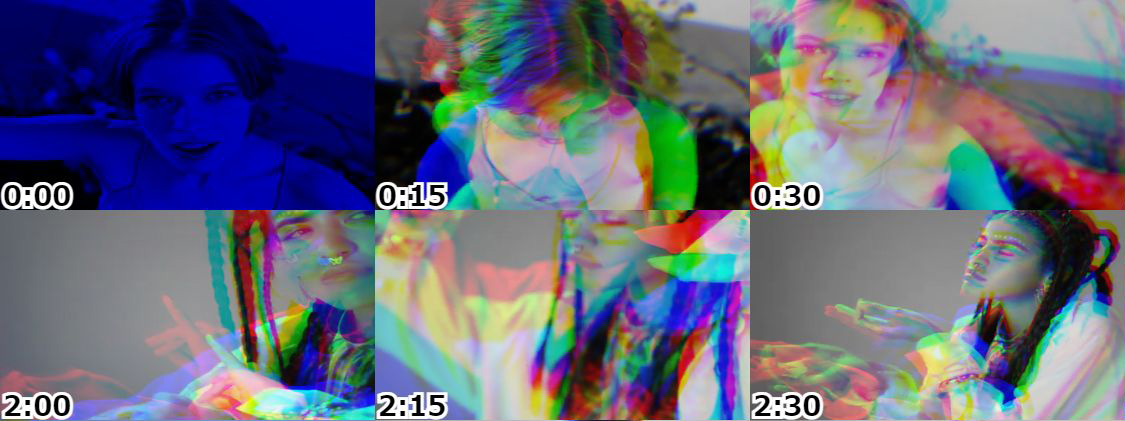
| Channel | Time | Meaning |
|---|---|---|
| R (Red) | T-0.5s | Past |
| G (Green) | T0 | Present |
| B (Blue) | T+0.5s | Future |
Motion appears as chromatic aberration. Static objects remain grayscale. Moving objects show RGB separation proportional to speed and direction.
AI perceives temporal flow from a single image—no video streaming required.
- VAM Seek AI - The Evolution
- VAM-RGB Defensive Publication (Zenodo) - Technical specification
Credits
Evolved from VAM Desktop.
Media Coverage
- 科技爱好者周刊(第 381 期) - Ruan YiFeng’s Blog (China)
- VAM Seek: 2D Visual Navigation for Videos Without Server Load - Ecosistema Startup
- VAM Seek: Lightweight 2D Video Navigation Without Server Load - Pulse Scope